Protecting against corrosion does not mean applying more and more protection.
Effective cathodic protection should provide the metal with the level of protection it actually requires, preventing values from becoming excessive.
This is one of the key aspects analysed during Tecnocorr’s sea trials, comparing the behaviour of traditional sacrificial anodes with the electronic E-Anode system.
Testing traditional sacrificial anodes
During the tests, the current output of aluminium and zinc sacrificial anodes installed on bare stainless-steel plates of different surface areas was measured.
| Configuration | Measured current |
|---|---|
| Aluminium Ø 90 mm – 0.35 m² plate | 40–56 mA |
| Aluminium Ø 125 mm – 0.35 m² plate | 48–57 mA |
| Aluminium Ø 90 mm – 0.70 m² plate | 54 mA |
| Aluminium Ø 125 mm – 0.70 m² plate | 88–102 mA |
| Zinc Ø 90 mm – 0.35 m² plate | 25–43 mA |
The most significant result emerged from the test in which the Ø 90 mm and Ø 125 mm aluminium anodes were installed together on the 0.70 m² plate: under these test conditions, strong overprotection of the metal was detected.
Why overprotection matters
A traditional sacrificial anode generates current through the potential difference between the anodic alloy and the metal being protected.
Current output therefore depends on the properties of the alloy, surface area, geometry, positioning and environmental conditions.
Under certain configurations, the resulting protection may therefore exceed the level actually required.
The E-Anode approach: measure and regulate
E-Anode changes the operating principle.
The electronic system monitors the condition of the structure and automatically regulates cathodic protection according to the values actually detected.
Instead of relying exclusively on the electrochemical behaviour of a sacrificial metal mass, E-Anode controls the process and modulates its output, providing the required level of protection without overprotection.
It represents the transition from passive protection to protection that is measured, regulated and verifiable over time.
Sea trials continue
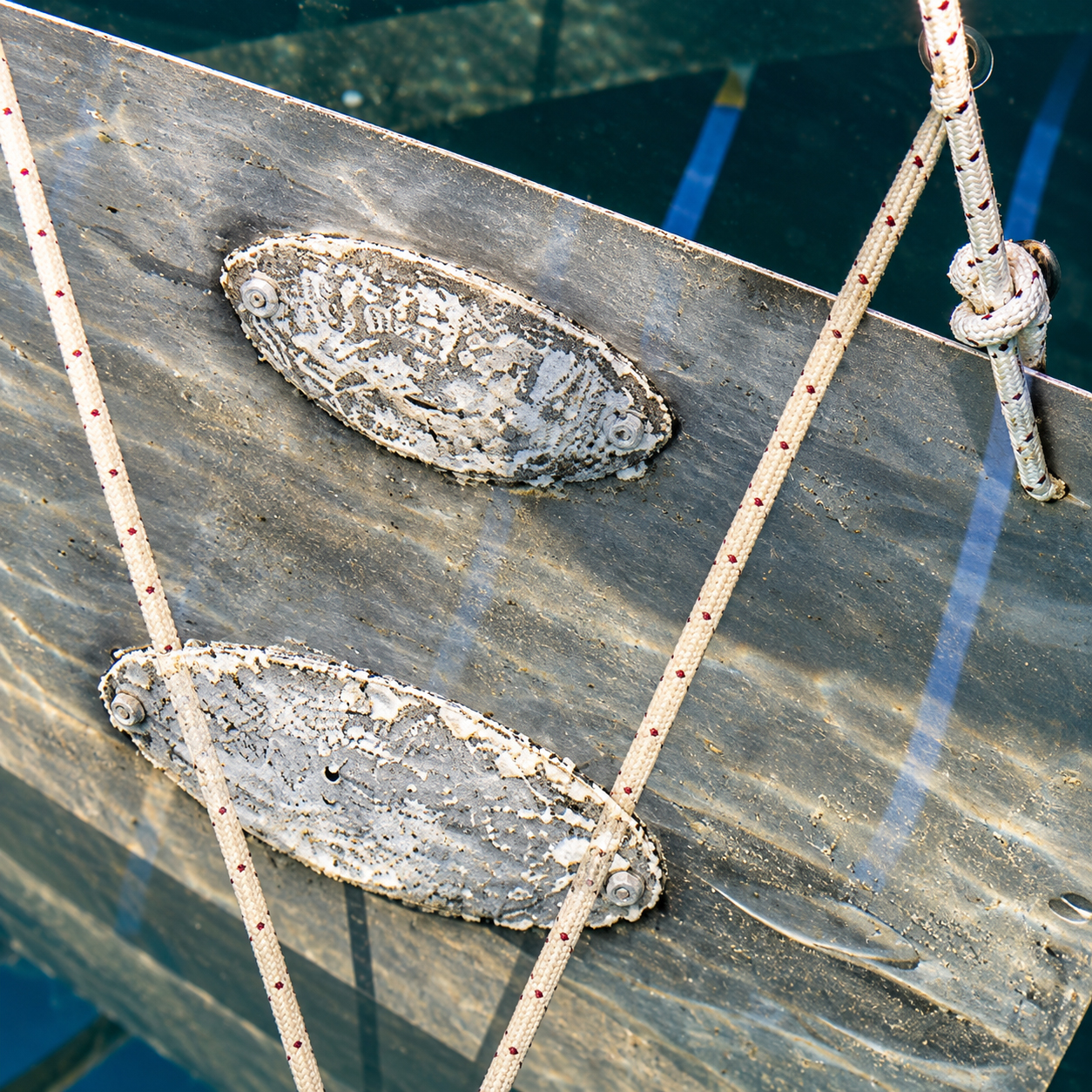
The images show E-Anode operating under real test conditions.
During its time in the water, marine organisms naturally approach and colonize the surface of the device: a striking image of a technology designed to operate within the marine environment without relying on the progressive consumption of sacrificial material.
Measure. Regulate. Protect.
Sea trials make it possible to see the difference between current output determined by the behaviour of a traditional anode and an electronic protection system capable of adapting to the actual condition of the metal.